
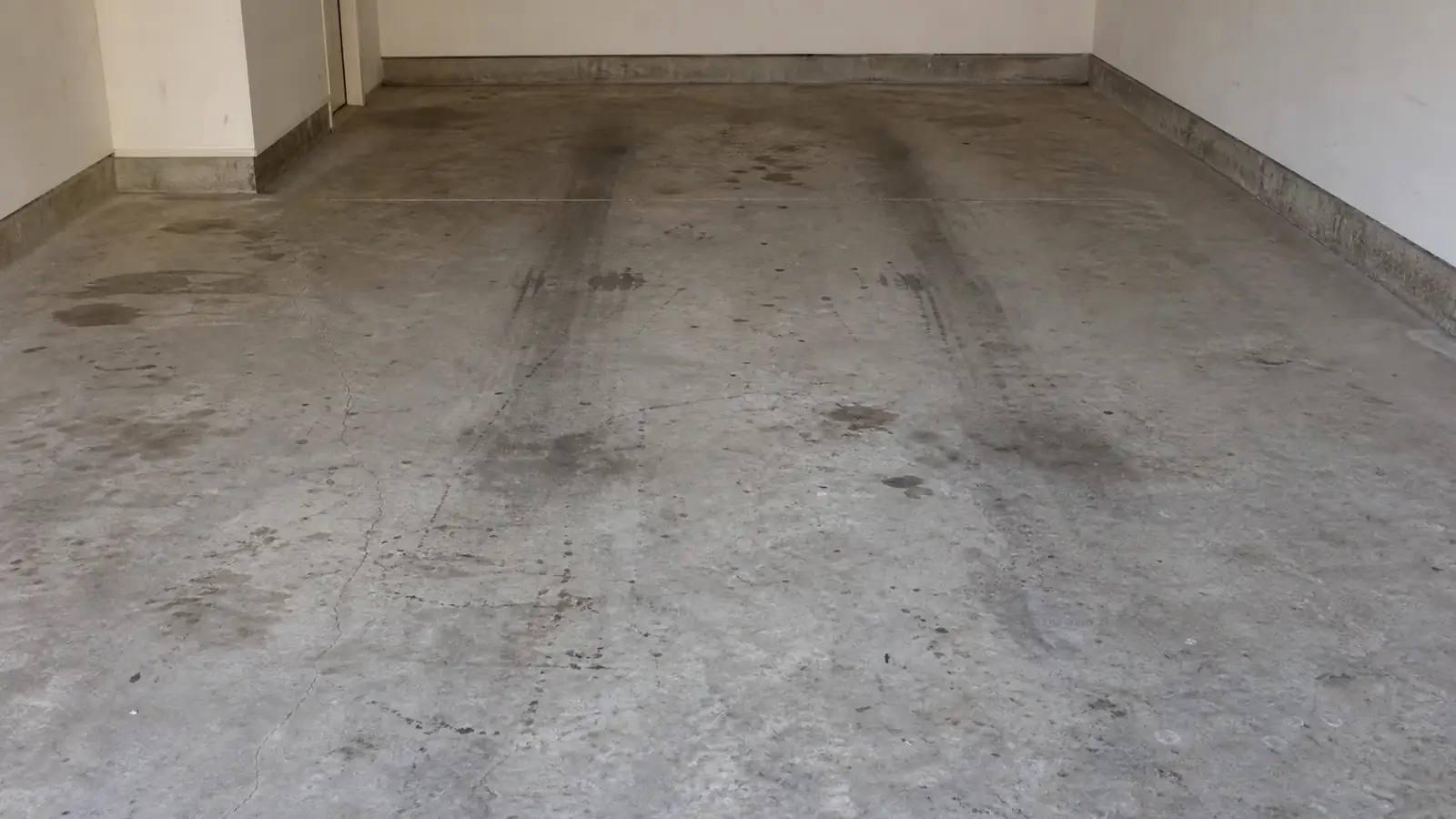
Yes, in most cases you can epoxy over old concrete, but not over the problem itself. Cracks are repaired, joints are treated, oil is ground and cleaned out, old coatings are tested or removed, and moisture is checked first. The coating is only as good as what it bonds to.
Yes, in most cases you can epoxy over old concrete, but not over the problem itself. Cracks are repaired, joints are treated, oil is ground and cleaned out, old coatings are tested or removed, and moisture is checked first. The coating is only as good as what it bonds to.
Most garage slabs are not pristine. They have hairline cracks, a few oil spots from the car that sat there for ten years, maybe an old coat of paint, and sometimes a joint that has opened up. None of that automatically rules out an epoxy floor, and none of it can be ignored. A coating bonds to concrete, so whatever is wrong with the concrete shows up in the floor sooner or later. This post covers what we do about each condition, how moisture testing fits in, and the cases where the honest answer is to fix something else first.
An epoxy floor does not hide a bad slab, it sits on it. The coating has to grip the concrete through a bonding profile, which we create by diamond grinding the surface. Grinding opens the pores, removes the weak top layer, and gives the basecoat something to lock into. Everything else in this post comes back to that idea. If there is a crack that moves, a stain that keeps seeping, an old coating that is peeling, or moisture coming up through the slab, the new coating will be stressed in exactly that spot. That is why a good installer spends more of the day on the slab than on the color. It is also why a very low price should make you ask what was left out. We inspect the slab at the free estimate, look for cracks, joints, stains, previous coatings and signs of moisture, and tell you plainly what we see. Some conditions are routine. A few call for extra steps or a different product. Occasionally, the right answer is to repair the slab first, and we will say so.
Cracks are the most common question, and the answer depends on the type. Hairline cracks are common in concrete as it cures and shrinks. We grind them, open them slightly if needed, and fill them with a repair material before coating, so they do not telegraph through the finish. Wider cracks, or cracks where one side sits higher than the other, need more care. A crack that is still moving cannot be locked in place by a rigid coating, so we look at whether it is stable. A decorative flake finish can help hide a repaired crack, because the pattern breaks up the line. A smooth solid color or a metallic floor shows repairs more, since the surface is uniform and glossy. Be realistic about this. Repair makes a crack stable and far less visible, but it does not always make it disappear, and a crack that opens again from slab movement can show through. If a crack looks structural, such as a wide gap, a large height change or signs of settlement, we will tell you to have it looked at by the right professional before coating. A coating is not a structural repair.
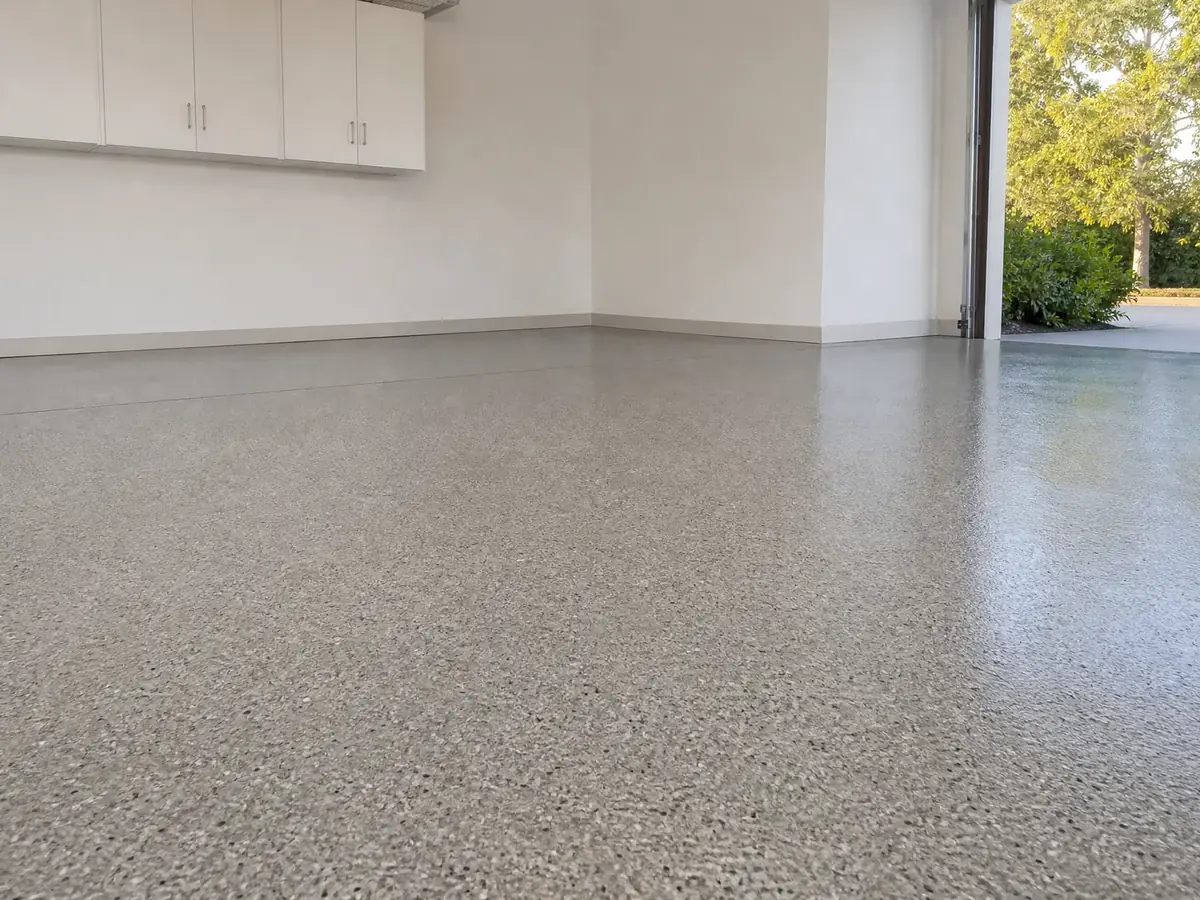
Concrete slabs have joints on purpose, cut or formed to let the slab move without cracking at random. Those lines are not defects, but they do need a plan. If we coat rigidly across a joint that still moves, the coating can crack along the line. In most garages, the usual approach is to clean the joint, fill it with a suitable joint filler and then coat across it or stop the coating at the joint, depending on the type of joint and how much movement it has. A true expansion joint, where two slabs are separated, is different from a sawcut control joint, and we treat them differently. At the estimate we look at where the joints are, how wide they are, and whether they have been filled before. You can ask us how each will be handled. You may see the line of a joint in the finished floor, and that is normal and honest. The aim is a floor that moves with the slab rather than fighting it, so the coating does not crack in the same place a few months later.
Moisture is the quiet reason some floors fail. Concrete holds and transmits water vapor, and if that vapor pushes up under a coating that cannot handle it, the result can be bubbles, blisters or a coating that lets go. Older slabs may have been poured without a vapor barrier under them, and many slabs sit on soil that stays damp from irrigation, drainage or plumbing leaks. You cannot judge this by looking. There are simple checks, such as taping a plastic sheet to the floor and seeing whether condensation forms, and there are more reliable tests, such as calcium chloride tests and in-slab relative humidity probes. Which one is right depends on the job. A moisture-barrier epoxy basecoat is designed to handle vapor transmission up to a point, and it is part of why we use it on residential floors. It is not magic, and a slab with heavy, ongoing moisture needs a fix at the source. If the testing shows a problem, we will tell you before we start, and we will not coat over it and hope for the best.
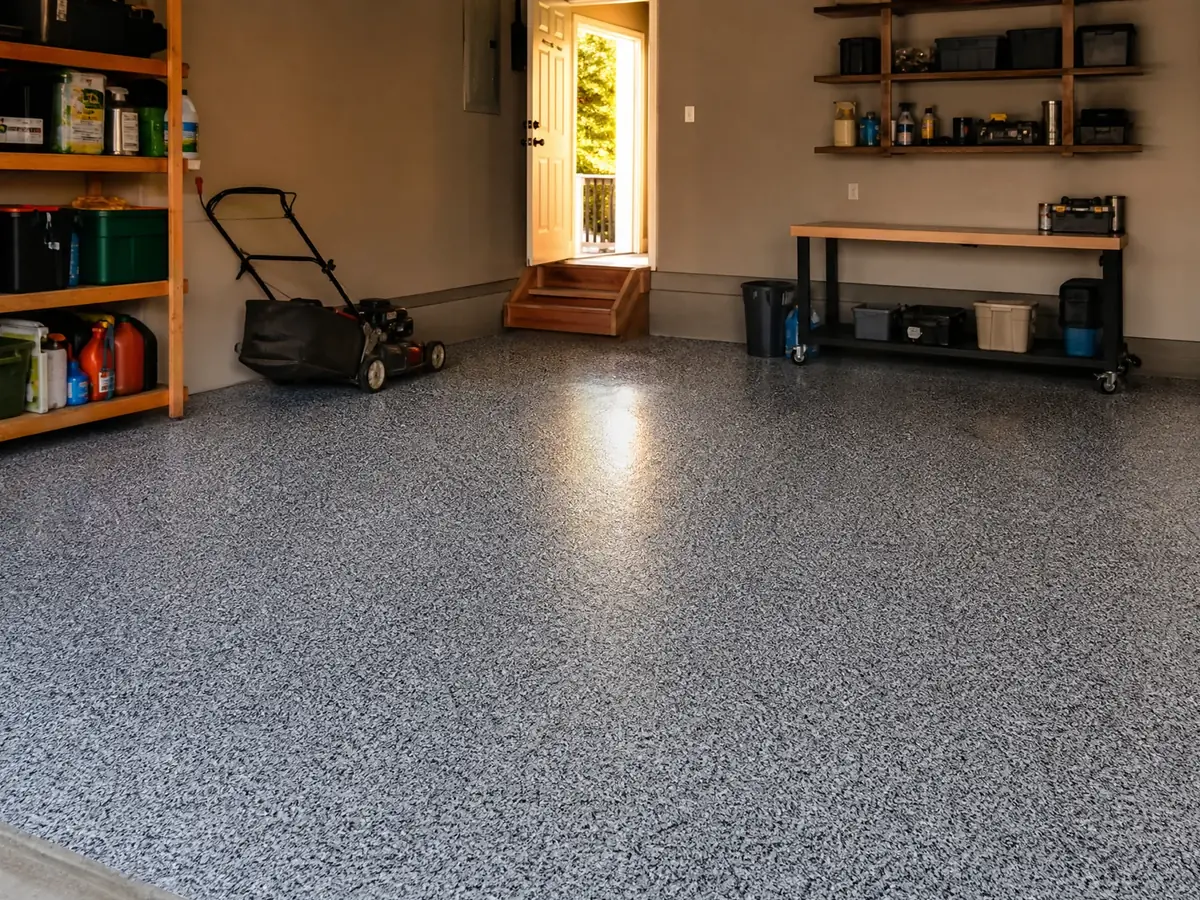
A garage that has hosted a leaking car for years will have oil in the concrete. Concrete is porous, so oil does not sit on top. It soaks in. Diamond grinding removes the top layer where much of it sits, and degreasing and cleaning handle the rest. Deep stains can remain in the pores, and oil can work its way back up over time, which can mark or weaken the bond in that spot. For heavy staining we use extra cleaning steps and a basecoat that suits the situation, and we talk with you about what is realistic. A flake floor is very forgiving here, because the full-rejection broadcast and topcoat bury the stain visually. A clear coat or a light solid color will show stains more if the concrete has any left. Tell us how long the leak went on and what fluid it was, because that changes the cleaning plan. A finished floor is highly resistant to oil on the surface, which makes later spills easy to wipe, though we would not call any floor impervious, and we will not promise a stain never returns.
If your floor has paint, a clear sealer or an older epoxy, the answer depends on how well it is stuck and what it is. We test adhesion, look for peeling, bubbling and wear, and check the thickness. A well-bonded thin coating can often be ground away along with the top of the concrete in the same pass. A failing coating has to come off completely, because a new coating over it will only be as strong as the old layer beneath. Some sealers and paints clog the surface, so we assess before we promise anything, and the grinding can take longer than on bare concrete. Tile adhesive, mastic and thick patches are other jobs entirely. If you are curious whether a grind and seal finish would suit an older slab better than a full epoxy system, we can compare the two. What we will not do is spray a new coating over loose paint and call it done. Show us the history if you know it, tell us if anyone applied a product, and we will plan the prep to match.
A cracked, stained or old slab can usually take an epoxy floor, as long as the prep is done properly. Expect crack repair, joint treatment, a moisture check and a ground surface, and be wary of anyone who skips them. Ask for a free estimate and we will inspect the slab and tell you what we find. Call (805) 697-5483 for a free estimate.
Yes, after the cracks are repaired. We grind them, fill them with a repair material and coat over the stable slab. Repair makes cracks far less visible, but a crack that keeps moving can reappear. A structural crack should be looked at before any coating.
Sometimes. A stable, properly filled crack usually stays hidden, especially under flake. A crack that is still moving can reopen through the coating. We inspect the slab at the estimate and tell you which cracks are a risk.
Yes, after the oil is dealt with. Grinding removes the top layer and cleaning removes more, but deep stains can remain in the pores. We use extra cleaning steps on heavy staining, and a flake finish hides any remaining marks very well.
Often yes, if it is tested first. Well-bonded thin coatings can usually be ground off with the surface. Failing paint or sealer has to be removed completely, because the new floor can only bond as well as the old layer beneath it.
Yes. Moisture in the slab can cause bubbles and peeling, and you cannot judge it by looking. There are simple checks and more precise tests. A moisture-barrier basecoat helps with vapor, but heavy ongoing moisture needs a fix at the source.
The coating can blister, bubble or lose its bond as vapor pushes up under it. A moisture-barrier basecoat can handle some vapor, but a very wet slab needs the source fixed first. We will tell you before starting if the testing shows a problem.
Durable, easy-to-clean garage floors that resist hot-tire pickup, oil and salt. Most two-car garages are done in one day.
Learn more →Diamond-ground concrete finished with a clear sealer for a natural, low-maintenance floor at the lowest installed price.
Learn more →Full-rejection flake over a moisture-barrier epoxy basecoat, sealed with a UV-stable polyaspartic topcoat. Installed in one day.
Learn more →We cannot give you a rule for every address, because requirements depend on your HOA and on the city. A coating is a surface finish, not structural work, but you should confirm it. Read your HOA documents, call the Simi Valley Building and Safety office, and get the answer in writing before you book.
Read the answer →A two-car flake epoxy garage floor in Simi Valley typically costs $2,600 to $4,000 for up to 400 square feet, or $6.50 to $10 per square foot. Our minimum project is $2,600. Solid color starts at $3,800, metallic runs $12.50 to $18.50 per square foot, and larger garages cost more because pricing follows square footage.
Read the answer →Yes, for most Simi Valley homeowners an epoxy garage floor is worth it when it is built properly: diamond ground, moisture tested and finished with a UV-stable topcoat. It ends concrete dust, resists oil and hot tires, and mops clean. It is not worth it over an unresolved moisture problem or with a thin, cheap coat.
Read the answer →Call (805) 697-5483 or send the form at the top of the page. We reply the same day.